Unlocking AI's Potential: The Comprehensive Benefits of a Managed AI Platform
In today's fast-paced digital landscape, artificial intelligence (AI) is no longer a luxury but a strategic imperative. From automating routine tasks to extracting complex insights from vast datasets, AI promises unparalleled competitive advantages. However, the journey to operationalizing AI is often fraught with challenges, including significant infrastructure complexities, spiraling costs, and specialized talent requirements.
Enter the managed AI platform. A managed AI platform offers a comprehensive solution that handles the entire lifecycle of AI operations, from infrastructure provisioning and model deployment to monitoring and maintenance, allowing businesses to focus purely on innovation rather than infrastructure management. This approach delivers substantial benefits, including reduced operational overhead, enhanced security, predictable costs, and accelerated time-to-value for AI initiatives.
Understanding Managed AI Platforms: Beyond IaaS
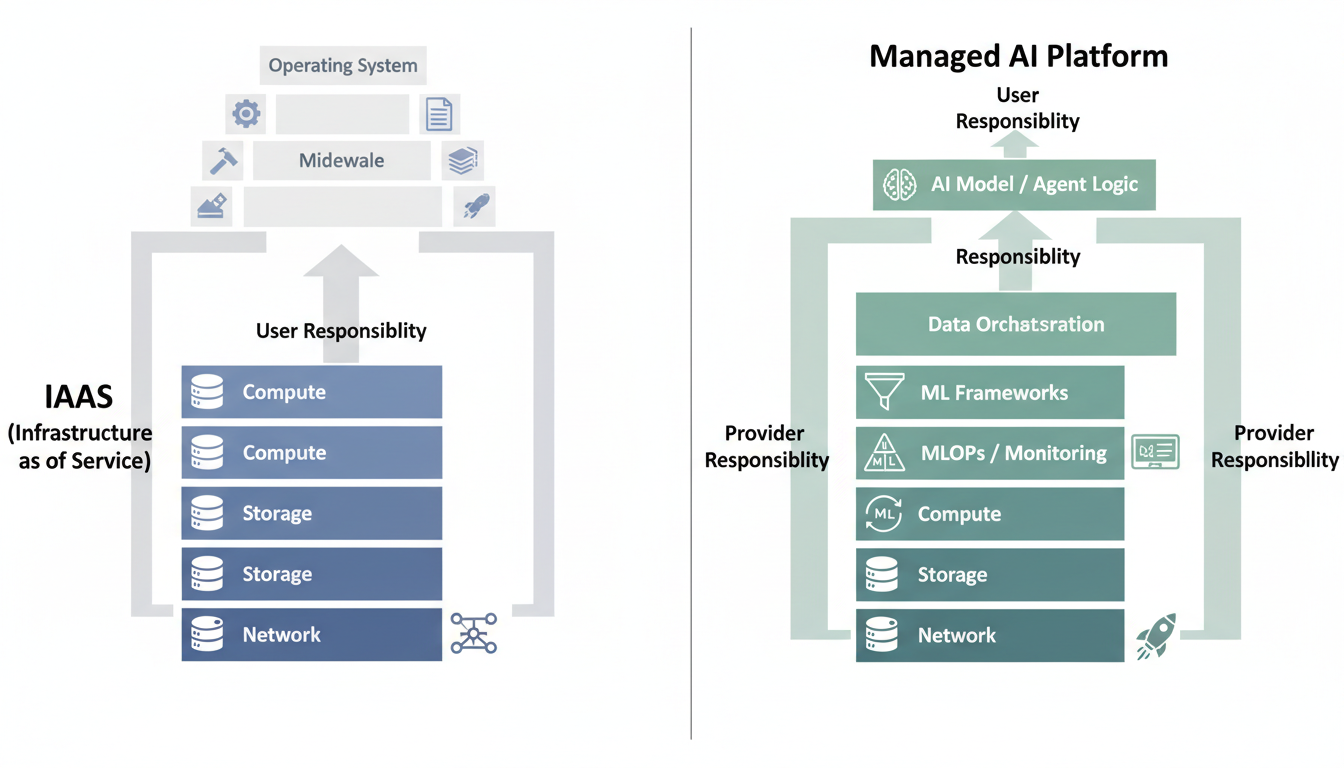
To truly appreciate the value of a managed AI platform, it's essential to understand how it differs from traditional Infrastructure as a Service (IaaS) offerings. While IaaS provides the raw computing power, storage, and networking resources, it places the full burden of setup, configuration, and ongoing management squarely on your team.
A managed AI platform goes several steps further. It's a specialized, end-to-end environment designed specifically for AI/ML workloads. Think of it as a complete toolkit and workshop, pre-configured and continuously maintained by experts. It abstracts away the intricacies of underlying hardware, software stacks, orchestration, and even aspects of MLOps (Machine Learning Operations).
Key components typically include:
- Pre-configured ML frameworks and libraries: Ready-to-use environments with popular tools like TensorFlow, PyTorch, Scikit-learn.
- Scalable compute resources: Access to GPUs, TPUs, and CPUs that automatically scale up or down based on demand.
- Data management and integration: Tools for data ingestion, storage, and preparation tailored for AI workloads.
- Model development and training environments: Integrated development environments (IDEs) and Jupyter notebooks.
- Model deployment and serving: Tools for deploying models into production, often with real-time inference capabilities.
- Monitoring and management: Dashboards and alerts to track model performance, resource utilization, and anomalies.
- Security and compliance: Built-in features to protect data and ensure regulatory adherence.
Key Advantages Over Self-Hosting AI Workloads
The decision to build and manage your AI infrastructure internally versus leveraging a managed service is a critical one. While self-hosting offers maximum control, it often comes at a steep price in terms of complexity, cost, and resource drain. The managed AI platform benefits are particularly pronounced when directly compared to the challenges of self-managed setups.
Streamlined Deployment and Management
Setting up an AI development and deployment environment from scratch is a monumental task. It involves configuring servers, installing dependencies, managing containerization (like Docker and Kubernetes), and ensuring seamless integration between various components. This process can take weeks or even months, diverting valuable engineering talent from core AI development.
A managed AI platform provides an 'out-of-the-box' solution. Environments are pre-built, dependencies are pre-installed, and orchestration is handled automatically. This drastically reduces the time from concept to deployment, allowing teams to focus on building, training, and iterating on AI models much faster. It's about reducing friction at every stage of the AI lifecycle.
Expertise On-Demand and Reduced Staffing Burden
Building and maintaining a robust AI infrastructure requires a diverse set of highly specialized skills: cloud architects, MLOps engineers, data engineers, and security specialists. These roles are scarce and expensive. Recruiting, training, and retaining such a team can be a significant challenge for many organizations.
With a managed AI platform, you effectively gain access to a team of experts without the hiring headache. The platform provider's specialists manage the underlying infrastructure, ensuring uptime, performance, and security. This frees your in-house AI talent to concentrate on the unique problems your business needs to solve with AI, maximizing their impact and reducing your overall staffing burden and associated costs.
Focus on Innovation, Not Infrastructure
The core objective of adopting AI is to innovate, create new products, optimize processes, and gain competitive intelligence. However, when your AI engineers are spending significant time troubleshooting infrastructure issues, patching servers, or optimizing resource allocation, their capacity for innovation is severely hampered.
A managed platform shifts this paradigm. By offloading the operational complexities, it empowers your team to spend more time on model experimentation, algorithm development, feature engineering, and understanding business problems. This acceleration of research and development directly translates into faster delivery of AI-powered solutions and a stronger competitive edge.
Scalability and Performance Optimization
AI workloads are notoriously resource-intensive and often unpredictable. Training large models requires significant compute power, while serving models in production demands low-latency inference capabilities that can scale rapidly with user demand. Manually managing this elastic scaling can be a nightmare.
Managed AI platforms are built for dynamic scalability. They automatically provision and de-provision resources (GPUs, CPUs, memory) as needed, ensuring optimal performance without over-provisioning. This intelligent resource management guarantees that your AI applications run efficiently and cost-effectively, whether you're training a massive neural network or serving millions of real-time predictions.
Cost Predictability and Efficiency
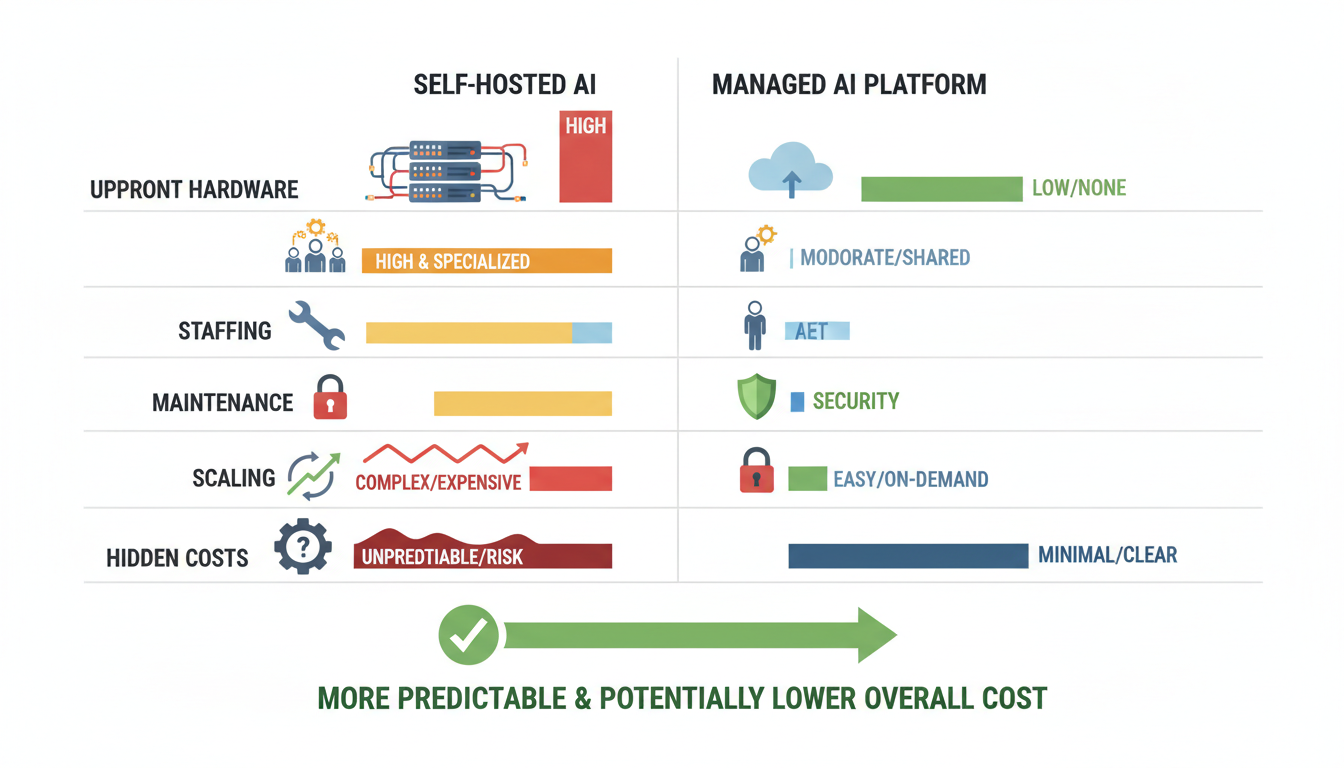
One of the most compelling managed AI platform benefits is the ability to control and predict costs. Self-hosting often involves significant upfront capital expenditures for hardware, software licenses, and recruitment. Furthermore, ongoing operational costs can be highly variable and difficult to forecast, encompassing unexpected maintenance, electricity, and the hidden costs of inefficient resource utilization.
Managed platforms typically operate on a subscription or consumption-based model. This translates into clear, predictable monthly costs, making budgeting simpler and more transparent. Providers often leverage economies of scale to offer compute resources at more favorable rates than individual enterprises could secure, further enhancing cost efficiency. You pay for what you use, scaled precisely to your needs, avoiding costly idle resources.
Reduced Operational Costs and Resource Allocation
Beyond the overarching benefits, a deep dive into the financial implications reveals significant operational cost savings and more strategic resource allocation when utilizing a managed AI platform. These savings often extend beyond just infrastructure, impacting personnel and opportunity costs.
Eliminating Hidden Costs of Self-Management
The true cost of self-managing AI infrastructure extends far beyond direct hardware and software expenses. Consider:
- Downtime costs: Every hour your AI system is down due to infrastructure failure, you lose revenue or operational efficiency.
- Security breach costs: The financial and reputational damage from a security incident can be immense.
- Inefficient resource provisioning: Over-provisioning to be safe leads to paying for idle compute. Under-provisioning leads to performance bottlenecks and delayed projects.
- Software licensing and maintenance: Keeping various software components up-to-date and compliant with licenses is an ongoing task.
- Staff turnover and training: High turnover in specialized roles incurs significant recruitment and training expenses.
A managed AI platform absorbs these hidden costs, bundling them into a transparent service fee. The provider is incentivized to maintain high availability, robust security, and efficient resource utilization, as it directly impacts their service level agreements (SLAs).
Optimized Resource Utilization
AI workloads rarely maintain constant resource demands. Training jobs might spike CPU/GPU usage for hours or days, then drop to near zero. Inference services might see peak usage during business hours and minimal activity overnight. Manually configuring infrastructure to match these fluctuating demands is incredibly complex and often inefficient.
Managed AI platforms excel at dynamic resource allocation. Through sophisticated orchestration and auto-scaling mechanisms, they ensure that compute, storage, and networking resources are precisely matched to the current workload requirements. This 'just-in-time' provisioning dramatically reduces waste, meaning you're only paying for the resources actively consumed by your AI models, leading to significant cost efficiencies compared to maintaining fixed, often over-sized, internal infrastructure.
Unlock the Full Potential of AI Agents in Your Business
Download our exclusive guide on 'Building and Scaling AI-Powered Companies' to discover best practices, use cases, and how Clippa.me streamlines your AI operations.
Predictable Budgeting
For many businesses, budget predictability is paramount. The variable nature of self-managed AI infrastructure, with unexpected hardware failures, scaling needs, or software licensing changes, makes accurate forecasting challenging.
Managed platforms typically offer clear, tiered pricing models or consumption-based billing that is easy to understand and project. This predictability allows finance teams to allocate budgets effectively and empowers AI leaders to plan projects without fear of unexpected infrastructure expenditures derailing their initiatives. It transforms a volatile expense into a manageable operational cost.
Enhanced Security and Compliance for AI
As AI systems become more integral to business operations, the security posture and compliance requirements become increasingly critical. AI models often process sensitive data, and their integrity is paramount. A security breach or compliance failure can lead to severe financial penalties, reputational damage, and loss of customer trust. This is another area where the managed AI platform benefits shine brightly.
Built-in Security Best Practices
Managed AI platforms are designed with security as a core principle. Providers implement enterprise-grade security measures across the entire stack, including:
- Network security: Firewalls, intrusion detection/prevention systems, virtual private clouds (VPCs).
- Data encryption: Encryption at rest and in transit for all data involved in AI workloads.
- Access control: Granular role-based access control (RBAC) to ensure only authorized personnel and systems can access specific resources and models.
- Vulnerability management: Regular patching, updates, and vulnerability scanning of all underlying software and infrastructure components.
- Hardened environments: Secure configurations for operating systems, containers, and AI frameworks.
These measures often far exceed what individual organizations can realistically implement and maintain internally, especially those without dedicated cybersecurity teams for AI/ML.
Regulatory Compliance and Data Governance
Many industries are subject to stringent regulatory compliance frameworks such as GDPR, HIPAA, CCPA, and ISO 27001. Ensuring that your AI systems and the data they process comply with these regulations is a complex legal and technical challenge.
Managed AI platform providers often build their services with compliance in mind, offering features and certifications that help customers meet their regulatory obligations. They can provide audit logs, data lineage tracking, secure data residency options, and documentation detailing their compliance efforts. This significantly reduces the burden on your legal and compliance teams, allowing them to focus on the application-level compliance rather than the infrastructure.
Proactive Threat Detection and Response
Cybersecurity threats are constantly evolving. A self-managed AI environment requires continuous monitoring, active threat intelligence gathering, and a robust incident response plan. This demands specialized security operations center (SOC) capabilities.
Managed AI platforms often include sophisticated monitoring tools and dedicated security teams that proactively detect and respond to potential threats. This includes monitoring for anomalous activity, known attack patterns, and zero-day vulnerabilities. Their expertise and resources ensure a faster, more effective response to security incidents, minimizing potential damage and downtime.
Clippa.me's Approach to Fully Managed AI Operations
At Clippa.me, we understand that while AI holds immense promise, its implementation should be simple, secure, and scalable. Our platform is meticulously designed to deliver the full spectrum of managed AI platform benefits, specifically tailored for organizations looking to run entire companies using advanced AI agents. We go beyond simply offering infrastructure; we provide a complete operational environment.
Simplifying Complex AI Agent Workflows
The vision of running a company with AI agents involves orchestrating numerous interconnected AI models, data pipelines, and decision-making processes. This complexity can quickly overwhelm internal teams trying to build it from the ground up. Clippa.me excels at abstracting this complexity.
Our platform provides intuitive tools and pre-built components that simplify the design, deployment, and management of sophisticated AI agent workflows. From agent design to task assignment and performance monitoring, Clippa.me offers a seamless experience that reduces the learning curve and accelerates time-to-market for your AI-powered operations.
Comprehensive End-to-End Management
Clippa.me takes ownership of the entire AI operations stack. This means we handle:
- Infrastructure provisioning: Automatic scaling of compute resources (GPUs, CPUs) for training and inference.
- Environment setup: Pre-configured and optimized environments with all necessary libraries and frameworks.
- Data integration: Seamless connectors to various data sources and secure data handling.
- Model lifecycle management: Tools for versioning, deployment, monitoring, and retraining of your AI agents.
- Security and compliance: Enterprise-grade security measures and features to help you meet regulatory requirements.
- Performance optimization: Continuous monitoring and tuning to ensure your AI agents operate at peak efficiency.
This holistic approach ensures that your team can dedicate 100% of its effort to defining business logic and refining AI agent intelligence, free from operational distractions.
Enterprise-Grade Reliability and Support
For businesses relying on AI agents to run core operations, reliability is non-negotiable. Clippa.me provides a robust, highly available infrastructure backed by comprehensive support. Our expert team monitors the platform 24/7, proactively identifies and resolves issues, and provides dedicated assistance to ensure your AI agents are always online and performing optimally. This level of reliability and expert support is difficult and costly to replicate in-house.
Direct Comparison: Clippa.me vs. AWS SageMaker/Google Vertex AI
While platforms like AWS SageMaker and Google Vertex AI offer powerful tools for machine learning, they often fall into the category of 'AI infrastructure as a service.' They provide building blocks but still require significant operational expertise and effort to assemble and manage a truly end-to-end AI system, especially for complex AI agent orchestrations.
Consider these differentiators:
- Operational Overhead: SageMaker and Vertex AI offer services, but you're still largely responsible for integrating them, managing MLOps pipelines, and ensuring continuous operations. Clippa.me provides a fully integrated, opinionated platform that manages these complexities for you.
- Focus: While the cloud giants serve a broad spectrum of ML needs, Clippa.me is specifically optimized for orchestrating and managing AI agents that can run entire company functions, providing specialized tools and workflows that simplify this complex domain.
- Time-to-Value: Setting up a production-ready AI agent system on generalized cloud platforms can take months of engineering effort. Clippa.me's managed approach significantly shortens this timeframe, allowing you to deploy and iterate on AI agents much faster.
- Expertise: With Clippa.me, you leverage our deep expertise in AI agent orchestration and MLOps as a service. On AWS or Google Cloud, you're expected to bring or acquire that expertise internally to fully utilize their services.
Frequently Asked Questions About Managed AI Platforms
Q: What's the main difference between a managed AI platform and cloud-based ML services like AWS SageMaker?
While cloud ML services provide powerful tools and infrastructure components, you are still largely responsible for integrating them, managing the MLOps pipeline, and handling day-to-day operations. A managed AI platform, like Clippa.me, provides a complete, pre-configured, and fully managed environment, abstracting away almost all infrastructure and operational complexities so you can focus solely on AI development.
Q: Is a managed AI platform only for large enterprises?
Not at all. While enterprises benefit from reduced complexity and cost, smaller businesses and startups gain an even greater advantage by accessing enterprise-grade AI infrastructure and expertise without the prohibitive upfront investment or the need to hire a large, specialized team. It democratizes advanced AI capabilities.
Q: How does a managed AI platform ensure data security and compliance?
Managed AI platforms incorporate robust security measures including encryption, granular access controls, network security, and continuous vulnerability management. Providers also often align with major compliance certifications (like GDPR, HIPAA, ISO 27001) to help customers meet their regulatory obligations, reducing the burden on your internal teams.
Q: Can I integrate my existing data sources with a managed AI platform?
Yes, most managed AI platforms offer flexible data integration capabilities, allowing you to connect to your existing databases, data lakes, and other data sources securely. This ensures that your AI models have access to the data they need without requiring complex data migration or re-architecture.
The future of business is intrinsically linked to the intelligent application of AI. However, navigating the technical complexities, managing operational costs, and ensuring robust security can be significant barriers. This is precisely where a managed AI platform provides an indispensable advantage.
By offloading the intricacies of AI infrastructure and operations, businesses can significantly reduce their time-to-market, optimize resource allocation, enhance security, and empower their teams to focus on strategic innovation. For organizations aiming to leverage the full power of AI agents to run intelligent operations, a platform like Clippa.me offers a clear path forward, transforming ambitious AI visions into tangible, impactful realities.