The AI-Powered CEO: Revolutionizing Business Leadership with AI Workforces
The idea of an AI-powered CEO might sound like a futuristic concept from a sci-fi novel, but it's rapidly becoming a reality for forward-thinking organizations. An AI-powered CEO leverages advanced artificial intelligence systems to automate strategic decision-making, manage intricate operations, and lead an AI workforce, fundamentally transforming traditional business leadership models.
This revolutionary approach allows companies to achieve unprecedented levels of efficiency, data-driven insights, and scalability. By integrating AI into the highest echelons of management, businesses are poised to navigate complex markets with agility and precision, ensuring sustained growth and innovation.
Stay Ahead in the AI Revolution: Subscribe to Our Newsletter!
Get exclusive insights into AI workforce management, emerging AI leadership trends, and practical strategies for integrating AI into your business. Join our community of AI innovators.
Defining the AI-Powered CEO Role in Modern Business
The AI-powered CEO is not a single sentient robot, but rather a sophisticated ecosystem of AI tools and algorithms designed to fulfill executive functions. This encompasses everything from strategic planning and market analysis to resource allocation and performance monitoring. Essentially, it's about delegating executive-level tasks to intelligent systems capable of processing vast amounts of data and identifying optimal pathways.
This role shifts human leadership from direct operational oversight to strategic guidance and ethical governance. Human executives focus on setting vision, fostering innovation, and ensuring the AI systems align with core company values. They become orchestrators of an advanced digital team, focusing on the "why" while the AI handles the "how."
Key Characteristics of an AI-Driven Leadership Approach
- Data-Centric Decision-Making: AI leaders process and analyze market trends, financial data, and operational metrics at speeds impossible for humans, leading to more informed and proactive decisions.
- Scalability and Efficiency: An AI workforce can scale operations up or down instantly, optimizing resource use and reducing overheads without human limitations.
- Unbiased Analysis: AI operates free from human biases, potentially leading to more objective and equitable outcomes in strategy and resource distribution.
- 24/7 Operation: AI systems can continuously monitor, analyze, and execute tasks around the clock, ensuring constant productivity and responsiveness.
- Predictive Capabilities: Leveraging machine learning, AI can forecast future trends, risks, and opportunities with remarkable accuracy, enabling proactive strategy adjustments.
How AI Takes on Strategic and Operational Tasks
The scope of tasks an AI-powered CEO can undertake is continuously expanding. From high-level strategic planning to granular operational management, AI's capabilities are redefining what's possible in business leadership.
Strategic tasks often involve complex pattern recognition and predictive modeling. For example, an AI can analyze global economic indicators, competitor strategies, and internal performance data to recommend optimal market entry points or product development priorities. It can even simulate various scenarios to predict the outcome of different strategic choices.
Examples of AI in Executive Functions
- Market Analysis & Strategy Formulation: AI algorithms can scour millions of data points from market reports, social media, news, and financial statements to identify emerging trends, customer sentiments, and competitive landscapes. This allows for the rapid formulation of data-driven market entry or expansion strategies.
- Financial Forecasting & Resource Allocation: Advanced AI models can predict financial performance with high accuracy, identifying potential risks and opportunities. This informs optimal budget allocation, investment decisions, and capital management.
- Supply Chain Optimization: AI can monitor global supply chains in real-time, predicting disruptions, optimizing logistics routes, and managing inventory levels to ensure seamless operations and reduce costs.
- Talent Acquisition & Management (AI Workforce Management): AI assists in identifying and recruiting top talent, personalizing employee training, and optimizing team structures. For an AI workforce, it manages agent performance, task distribution, and resource needs.
- Customer Relationship Management (CRM): AI-driven CRM systems predict customer needs, personalize interactions, and automate support, enhancing customer satisfaction and loyalty.
Building an Effective AI Leadership Team
Creating an effective AI leadership team requires more than just deploying off-the-shelf AI tools. It demands a deliberate strategy for AI workforce management, integrating various AI agents and systems into a cohesive, goal-oriented unit. This is where platforms designed for creating and overseeing AI agents become indispensable.
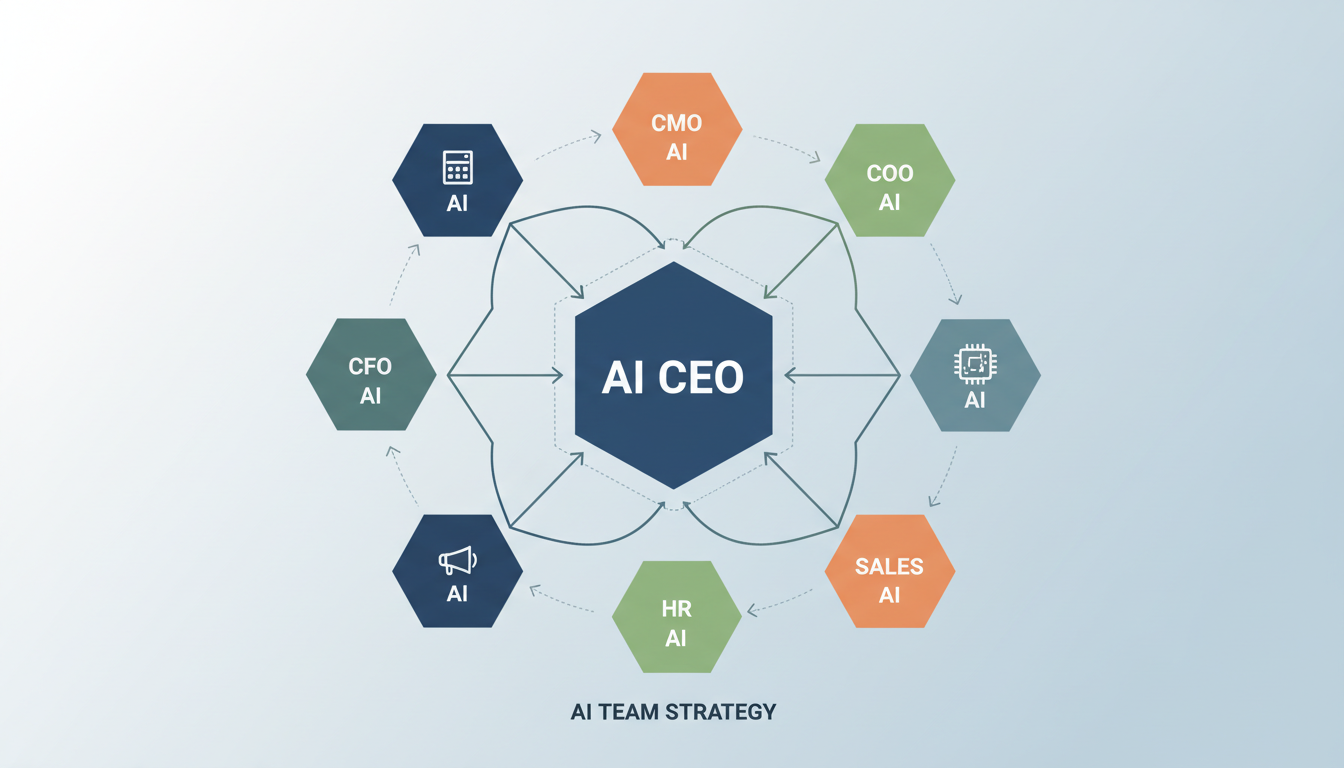
Imagine assembling a team where each member is an AI agent, specialized in a particular executive function. One AI might be a 'Chief Marketing Officer,' another a 'Head of Operations,' and yet another a 'Financial Analyst.' The AI-powered CEO then acts as the central orchestrator, directing these specialized agents, analyzing their outputs, and ensuring their collective efforts align with overarching business objectives. This embodies the true AI team strategy.
Clippa.me: Empowering Your AI Workforce
Platforms like Clippa.me are at the forefront of enabling this new paradigm. Clippa.me specifically allows for the creation and management of advanced AI roles, including a 'CEO' AI. This unique capability showcases its power in building and orchestrating a full AI workforce.
With Clippa.me, you can:
- Define Custom AI Roles: Create specialized AI agents for various executive functions, from strategic planning to operational oversight.
- Orchestrate AI Workflows: Design complex workflows where AI agents collaborate, share data, and execute multi-step processes autonomously.
- Monitor Performance: Gain real-time insights into the performance of your AI workforce, ensuring tasks are completed efficiently and effectively.
- Iterate and Optimize: Continuously refine AI agent behaviors and strategies based on performance data, driving continuous improvement.
By providing the tools to build and manage such sophisticated AI teams, Clippa.me empowers businesses to truly embrace the future of work AI.
Ethical Considerations and Oversight for AI Leaders
While the benefits of an AI-powered CEO are immense, integrating AI into leadership roles comes with significant ethical and oversight responsibilities. It’s crucial to establish robust frameworks to ensure AI systems operate responsibly, transparently, and in alignment with human values.
Bias in AI is a paramount concern. If AI models are trained on biased data, they can perpetuate or even amplify those biases in their decisions. This necessitates careful data curation, continuous monitoring, and the implementation of fairness algorithms. Accountability is another key area; clear lines of responsibility must be established, even when an AI makes a critical decision. Ultimately, human oversight remains indispensable to guide and govern these powerful systems.
Ensuring Responsible AI Leadership
- Transparency and Explainability: Demand AI systems that can explain their decision-making processes, even if simplified, to build trust and allow for auditing.
- Bias Detection and Mitigation: Implement tools and processes to regularly audit AI models for biases in data and outcomes, actively working to neutralize them.
- Human-in-the-Loop Safeguards: Design systems that require human approval for high-stakes decisions or intervention in ambiguous situations.
- Legal and Regulatory Compliance: Ensure AI operations adhere to all relevant data privacy, consumer protection, and industry-specific regulations.
- Ethical AI Governance Board: Establish a diverse team responsible for setting ethical guidelines, reviewing AI decisions, and ensuring alignment with corporate values and societal good.
The Transformative Impact on Decision-Making and Growth
The emergence of the AI-powered CEO marks a profound shift in business dynamics. This new leadership paradigm promises to unlock unprecedented levels of accuracy in decision-making and accelerate growth trajectories.
By removing the limitations of human processing speed and cognitive biases, AI can identify patterns and opportunities that might otherwise be missed. This leads to more agile and responsive strategies, allowing businesses to adapt quickly to market changes and preempt competitive threats. The result is not just incremental improvement, but often exponential growth driven by intelligent, autonomous operations.
Key Transformative Outcomes
- Enhanced Agility: Businesses can respond to market shifts and emerging trends with unparalleled speed, outmaneuvering slower competitors.
- Optimized Resource Utilization: AI ensures that capital, talent, and operational resources are deployed where they will yield the highest return.
- Innovation Acceleration: By automating routine and analytical tasks, human teams are freed up to focus on creative problem-solving and breakthrough innovation.
- Superior Competitive Advantage: Companies leveraging an AI-powered CEO can gain a significant edge through superior intelligence, efficiency, and adaptability.
- Sustainable Growth Models: Data-driven decisions powered by AI lead to more robust and sustainable growth strategies, reducing risk and maximizing long-term potential.
Frequently Asked Questions About the AI-Powered CEO
Q: Will an AI-powered CEO replace human CEOs entirely?
No, the AI-powered CEO is envisioned as a complement to, rather than a replacement for, human leadership. Human executives will shift their focus to higher-level strategic vision, ethical oversight, and fostering innovation, while AI handles data-intensive operational and tactical decisions.
Q: What skills are needed for human leaders in an AI-powered organization?
Human leaders will need strong skills in critical thinking, ethical reasoning, data interpretation, AI system governance, and collaborative decision-making with AI. Emotional intelligence and creativity will also become even more valuable.
Q: How does an AI workforce differ from traditional automation?
Traditional automation often involves rule-based, repetitive tasks. An AI workforce, conversely, comprises intelligent agents capable of learning, adapting, making complex decisions, and even collaborating to achieve strategic objectives, mirroring a human team but with AI capabilities.
The journey toward an AI-powered CEO is not merely about adopting new technology; it's about fundamentally rethinking the nature of business leadership. As AI continues to evolve, its capacity to manage, strategize, and optimize will only grow, creating a future where human ingenuity and artificial intelligence work hand-in-hand. Embracing this shift will be crucial for any organization aiming to thrive in the complex, data-driven economy of tomorrow. The future of work AI is here, and it's redefining leadership one intelligent decision at a time.