Serverless AI vs. Self-Hosting: Why Managed AI Platforms Lead the Way for Workloads
In the rapidly evolving landscape of artificial intelligence, organizations face a critical decision: how to deploy and manage their AI workloads. The choices often boil down to self-hosting your AI infrastructure, leveraging generic serverless computing, or opting for a fully managed AI platform. For businesses looking for optimized performance, reduced operational overhead, and accelerated time-to-value, a fully managed AI platform stands out as the unequivocally superior choice, especially for complex AI workforces and agents.
This article will meticulously compare the nuances of serverless AI vs self-hosting and then elevate the discussion to illustrate the profound advantages of adopting a comprehensive, managed AI solution like Clippa.me. We'll uncover the hidden complexities and costs of self-hosting, explore the partial benefits of generic serverless, and ultimately demonstrate why a dedicated managed platform is the strategic imperative for scaling AI success.
The AI Infrastructure Dilemma: Self-Hosting vs. Serverless vs. Managed
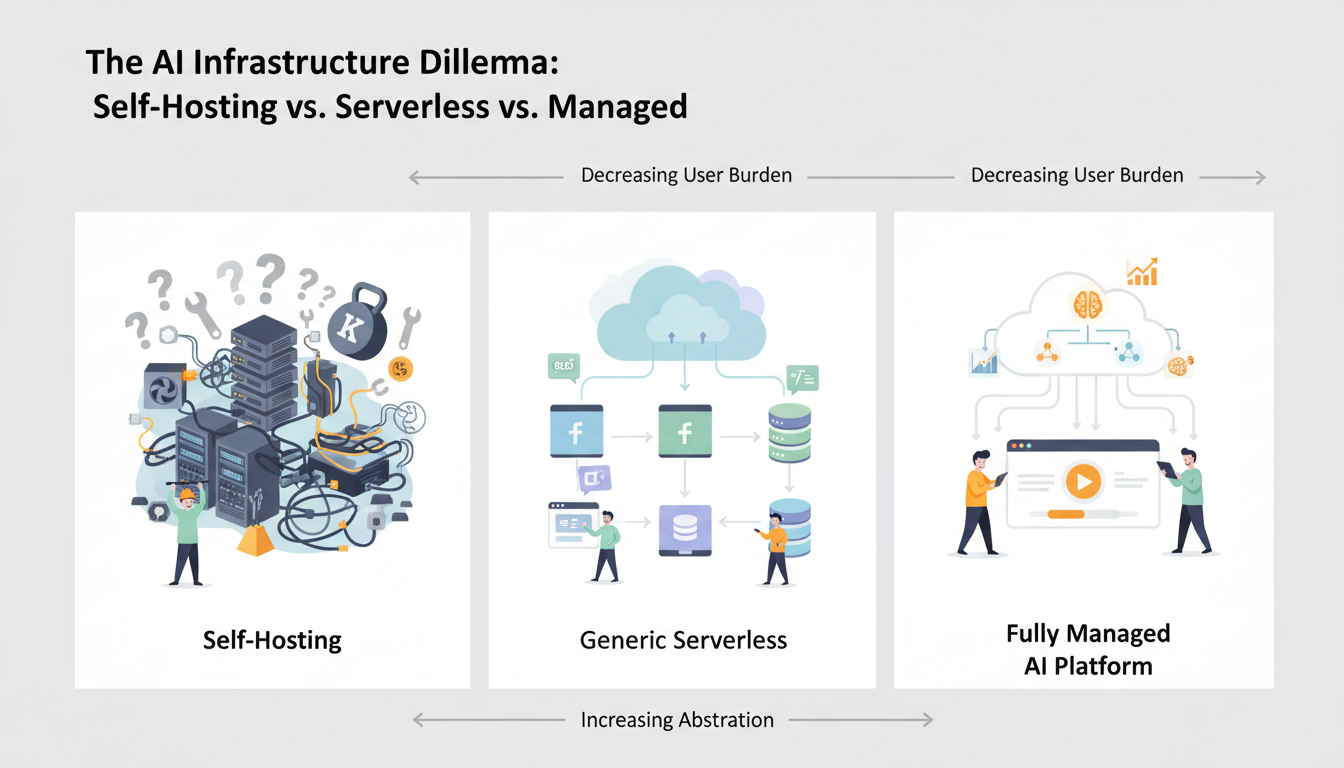
The foundation upon which your AI models operate dictates their efficiency, scalability, and ultimately, your project's success. As AI applications grow in complexity, the infrastructure demands shift dramatically. Understanding the fundamental differences between the primary deployment strategies is the first step toward making an informed decision.
- Self-Hosting (On-Premises or IaaS): This traditional approach involves provisioning and managing all hardware, software, and networking components yourself. Whether it's physical servers in your data center or virtual machines on an Infrastructure-as-a-Service (IaaS) cloud provider, the responsibility for setup, maintenance, and scaling rests entirely with your team.
- Generic Serverless AI (FaaS): This model abstracts away server management, allowing developers to deploy code functions (e.g., inference endpoints) that execute in response to events. Providers automatically manage the underlying infrastructure, scaling resources up or down as needed. While it removes server maintenance, the AI-specific orchestration, data pipelines, and MLOps tooling often remain a developer's burden.
- Fully Managed AI Platform (PaaS/SaaS): This represents the highest level of abstraction, providing a complete environment tailored specifically for AI development, deployment, and management. A managed platform handles not just the infrastructure but also the MLOps tooling, model versioning, monitoring, data integration, and often provides pre-built components or an AI agent framework. It's designed to streamline the entire AI lifecycle.
Understanding the True Costs and Complexities of Self-Hosting AI Workloads
While self-hosting offers maximum control, it comes at a steep price, often hidden beneath apparent cost savings. For AI workloads, which are inherently resource-intensive and dynamic, these costs and complexities multiply.
- Capital Expenditure (CapEx) & Hardware Procurement: Investing in powerful GPUs, specialized servers, and high-speed networking can be a massive upfront cost. This hardware depreciates quickly and requires significant lead time for procurement and setup.
- Operational Expenditure (OpEx) & Maintenance Overheads: Beyond initial purchase, self-hosting demands continuous operational expenditure. This includes electricity, cooling, physical security, and ongoing hardware maintenance. Failures can lead to costly downtime and data loss.
- Talent Acquisition & Retention: Building an in-house team capable of managing AI infrastructure requires highly specialized skills: DevOps engineers, MLOps specialists, network architects, and security experts. Such talent is scarce and expensive to attract and retain, diverting resources from core AI development.
- Scaling Challenges: AI workloads are rarely static. Scaling self-hosted infrastructure up or down to meet fluctuating demands is a manual, time-consuming process. Over-provisioning leads to wasted resources, while under-provisioning causes performance bottlenecks and missed opportunities.
- Security & Compliance Burden: Protecting sensitive AI models and data is paramount. Self-hosting means your team is solely responsible for implementing and maintaining robust security protocols, managing access controls, patching vulnerabilities, and ensuring compliance with industry regulations (e.g., GDPR, HIPAA, CCPA). This is a monumental and ever-evolving task.
- Software & Tooling Management: From operating systems and container orchestrators (like Kubernetes) to machine learning frameworks (TensorFlow, PyTorch) and MLOps tools, your team must install, configure, update, and troubleshoot a vast software stack. Compatibility issues and version conflicts are common time sinks.
- Reliability & High Availability: Ensuring your AI systems are always available and resilient to failures requires complex architectural design, redundancy, and disaster recovery planning – all significant undertakings for an in-house team.
Why Generic Serverless AI Offers Agility but Still Lacks Full Management
Generic serverless computing (often Function-as-a-Service or FaaS) marked a significant leap forward in cloud computing. It solved many pain points associated with traditional server management, offering undeniable advantages for certain AI tasks.
- Automatic Scaling: Serverless functions scale automatically from zero to handle millions of requests, removing the need for manual provisioning and capacity planning. This is ideal for bursty AI inference tasks.
- Pay-per-Execution Cost Model: You only pay for the compute time consumed by your functions, eliminating costs for idle resources. This can be highly efficient for intermittent AI workloads.
- Reduced Server Management: Developers are freed from patching servers, updating operating systems, or managing virtual machines, allowing them to focus more on code.
- Faster Deployment: The simplified deployment model of serverless functions can accelerate the release cycle for new AI features or models.
However, for comprehensive AI development and the orchestration of complex AI agents, generic serverless solutions still present significant gaps:
- Limited AI-Specific Tooling: FaaS platforms are general-purpose. They don't inherently provide tools for MLOps, experiment tracking, model versioning, feature stores, or robust data pipeline integration that are crucial for AI development.
- Cold Starts & Latency: While often negligible for web services, the 'cold start' issue (where a function takes longer to initialize if it hasn't been used recently) can be problematic for latency-sensitive AI inferences.
- Resource Constraints: Generic serverless functions often have limits on memory, CPU, and execution duration, which can hinder the deployment of large, complex AI models or long-running training jobs.
- Orchestration Complexity: Building sophisticated AI workflows involving multiple models, data sources, and agent interactions requires significant effort to orchestrate disparate serverless functions and other services.
- Vendor Lock-in (at the code level): While the underlying infrastructure is abstracted, the specific APIs and event models of serverless platforms can lead to a form of vendor lock-in, making migration challenging.
- Lack of AI Workforce Management: Generic serverless provides a compute primitive, not a framework for building, deploying, monitoring, and managing an entire workforce of AI agents that need to collaborate and execute complex tasks.
Unlock the Future of AI Workloads: Get a Personalized Demo of Clippa.me
See firsthand how Clippa.me's fully managed serverless AI platform can streamline your AI agent deployment, reduce operational costs, and accelerate your time to value. Book a quick, tailored demonstration with our experts.
Beyond Generic Serverless: The Value of a Fully Managed AI Platform
This is where the fully managed AI platform truly shines, moving beyond the simple 'serverless' concept to offer an end-to-end solution for the entire AI lifecycle. A managed platform takes on the heavy lifting that both self-hosting and generic serverless leave to the user, providing a complete, optimized environment for AI workloads.
- End-to-End MLOps Automation: From data ingestion and model training to deployment, monitoring, and retraining, a managed platform automates and streamlines the entire MLOps pipeline. This significantly reduces manual effort and potential for errors.
- Optimized for AI/ML: These platforms are built from the ground up with AI in mind. They often include specialized hardware acceleration (GPUs), pre-optimized libraries, and frameworks, ensuring peak performance for your models.
- Pre-built Components and Services: Managed platforms frequently offer out-of-the-box components for common AI tasks, such as model serving, feature engineering, data labeling, and experiment tracking. This accelerates development and reduces time-to-market.
- Simplified Scaling & Resource Management: True managed platforms handle not just the scaling of compute but also the optimized allocation of GPU resources, storage, and networking specifically for AI tasks. You get the benefits of elastic scalability without the operational burden.
- Robust Monitoring & Observability: Comprehensive monitoring tools are integrated to track model performance, data drift, resource utilization, and potential anomalies, providing crucial insights for continuous improvement and operational stability.
- Enhanced Security & Compliance: The platform provider is responsible for maintaining the security of the underlying infrastructure and often offers built-in features for data encryption, access control, and compliance certifications, easing your regulatory burden.
- Focus on Innovation, Not Infrastructure: By offloading the complex infrastructure and MLOps challenges, your data scientists and AI engineers can dedicate their time to building innovative AI models and developing business-driving solutions, rather than being bogged down by IT operations.
Clippa.me: The Ultimate Managed Serverless AI Solution for AI Workforces
Clippa.me transcends the limitations of both self-hosting and generic serverless offerings by providing a purpose-built, fully managed platform designed for the operationalization of AI workloads, specifically focusing on complex AI agents and workforces. We understand that deploying a single AI model is just the beginning; managing a collaborative team of AI agents requires a different paradigm.
Clippa.me isn't just about running serverless functions; it's about providing the entire ecosystem needed to build, deploy, monitor, and scale your AI agents as a cohesive workforce. Our platform eliminates the traditional infrastructure headaches and MLOps complexities, enabling your team to focus solely on defining agent behaviors and business logic.
Our approach is rooted in the belief that managing an AI enterprise should be as seamless as using a professional tool, not an IT project. We combine the agility of serverless with the robustness of a managed MLOps pipeline, specifically tailored for multi-agent systems.
With Clippa.me, you gain:
- Dedicated AI Agent Orchestration: Tools and frameworks specifically designed to manage the interactions, task allocation, and collaboration between multiple AI agents.
- Seamless Model Integration: Easily deploy and integrate various AI models (LLMs, vision models, custom models) into your agents without worrying about underlying infrastructure.
- Automated MLOps for Agents: Automated pipelines for agent versioning, testing, deployment, and performance monitoring, ensuring your AI workforce is always optimized and up-to-date.
- Scalability for AI Workforces: Our platform is engineered to effortlessly scale your AI agents as your operational needs grow, handling peak demands without manual intervention.
- Enterprise-Grade Security and Compliance: Built-in security features and compliance adherence to protect your data and AI assets, allowing you to deploy with confidence.
- Developer-Friendly Experience: An intuitive interface and powerful APIs designed to empower developers and AI engineers to quickly build and iterate on complex AI agent systems.
Clippa.me transforms the abstract concept of an 'AI workforce' into a tangible, manageable, and scalable reality for your business.
Key Advantages of Choosing Clippa.me for Your AI Workloads
When comparing serverless AI vs self-hosting, Clippa.me offers a compelling case for efficiency, innovation, and strategic advantage. Here's a breakdown of the distinct benefits you unlock with our managed platform:
- Rapid Development & Deployment: Accelerate your AI initiatives significantly. Instead of spending months setting up infrastructure and MLOps pipelines, you can deploy your first AI agent in days or weeks. Our platform provides the necessary environment to swiftly iterate on agent logic and deploy updates without friction.
- Significant Cost Savings: Eliminate the massive upfront capital expenditures and ongoing operational costs associated with self-hosting. Clippa.me's pay-as-you-go model (or subscription based on usage) means you only pay for what you consume, making your AI budget predictable and optimized. Furthermore, reduce the need for a large, specialized MLOps team.
- Unparalleled Scalability & Reliability: Clippa.me's infrastructure is built for elasticity, ensuring your AI agents can handle fluctuating demand without performance degradation. Our robust, highly available architecture guarantees continuous operation, minimizing downtime and maximizing productivity.
- Reduced Operational Burden: Offload the complexities of infrastructure management, patching, security updates, and MLOps toolchain maintenance to our expert team. Your engineers can dedicate their valuable time to innovative AI solutions, not plumbing.
- Focus on Business Logic, Not Infrastructure: Empower your AI developers to focus on the unique intelligence and tasks of your AI agents, rather than the underlying technical stack. This direct alignment with business objectives drives faster ROI and more impactful AI applications.
- Built-in Best Practices for MLOps: Leverage Clippa.me's integrated MLOps framework, which incorporates industry best practices for model versioning, continuous integration/continuous deployment (CI/CD) for agents, monitoring, and automated retraining. This ensures the health and accuracy of your AI workforce over time.
- Future-Proofing Your AI Strategy: As AI technologies evolve, so does Clippa.me. Our platform is continuously updated with the latest advancements in AI models, hardware, and MLOps techniques, ensuring your AI workforce remains at the cutting edge without requiring you to constantly re-architect your infrastructure.
The choice between self-hosting, generic serverless AI, and a fully managed AI platform is clear for forward-thinking organizations. While self-hosting imposes an unsustainable burden of cost and complexity, and generic serverless offers only partial relief, a truly managed AI platform like Clippa.me provides the comprehensive solution needed for modern AI workloads.
By embracing a managed serverless AI platform, you gain unparalleled agility, efficiency, and the ability to scale your AI workforce with confidence. You free your valuable talent to innovate, reduce operational risks, and ultimately accelerate your journey toward becoming an AI-driven enterprise. Stop managing infrastructure and start managing intelligence with Clippa.me.